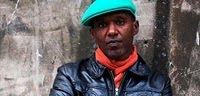
"Poet Lemn Sissay had a traumatic childhood in the care of social services. Now he wants to make sure it doesn't happen to other children"
From The Times
September 30, 2008
by Penny Wark
"You'd expect a poet to be self-conscious about the way he tells his story, and Lemn Sissay is. He comments on the structure of his sentences, apologises when they're not pretty enough. Sometimes he talks in riddles that neither of us can quite work out, so we leave them and move on because, in truth, there is no way to make sense of the mess that characterised the first half of Sissay's life.
We are talking about the care system that, in theory, provided Sissay with support and structure from the age of three months, when his mother handed him to a social worker, until his 18th birthday. In practice there was no consistent support and no structure, just a tangle of decisions, each taken unilaterally and with little consideration of the consequences for the cheerful young boy who, more than anything else, wanted to belong to a family. As a teenager, bewildered by the knowledge that he was attached to no one, he walked barefoot for a year. Even in the snow.
“I was aware that I'd been cheated but all anybody ever said was ‘It's not our fault.' That was always the answer to a very simple question, which is, ‘Why am I here?' I knew there was something wrong with this and that if I went crazy I was right to. I had these thoughts at 15 or 16 with no mother, father, sister, brothers, aunts, uncles, cousins. I didn't know one person who could relate to me when I was under 11, to the person I was as a young boy. You sort of get through, so I went barefoot. I just stopped wearing shoes for a year.”
Today Sissay is an artist in residence at the Southbank Centre in London. He's busy with writing and performing and TV (among more obviously right-on cultural endeavours, he is a Grumpy Old Man) and he arrives at our meeting in a look-at-me green Kangol cap and glittering shades. The poise evaporates the moment we sit down to talk because, although this story is what makes Sissay who he is, discussing it is no longer a source of discovery, but rather a reminder of the hurt and sense of rejection that, even now, fills his eyes when he recalls the details.
If this seems like a form of masochism, Sissay has a purpose: he wants to support Action for Children (formerly NCH), which is calling on the Government to provide consistent and long-term policies for vulnerable children. In the past 21 years there have been 82 strategies, 77 initiatives and 50 new funding streams relating to the services used by children. This constant wavering of policy does not serve their needs, says AfC, and, although Sissay was born in 1967, his experience of an erratic and apparently unregulated care system is pertinent.
And so he tells his story, prefacing it by saying that he discovered the facts about his birth parents only as an adult. When he was a child there were no explanations from Wigan social services. All he knew was that he was different: he was the only black person in his community, first in Ashton-in-Makerfield, later in the mining town of Atherton.
His mother was an Ethiopian student, who, in 1967, came to the UK to study, had a baby and asked if her son could be fostered for a short time. His social worker named the baby Norman after himself and arranged for him to be fostered by a white family, telling them that the mother would sign adoption papers in due course. “The message I got from my foster mother was that my parental mother was being awkward in not signing the adoption papers, but she obviously would,” says Sissay.
When he was 11, seated at the dining-room table, he was asked if he loved his foster family. For a bright child who had been brought up by a family he describes as fire and brimstone Baptists, this was a loaded question. “My foster mother said, ‘You don't love us, do you?' I said, ‘Well, I do.' She said, ‘Go away and think about it and come back tomorrow.' I studied the Bible and came up with what I thought was a perfect answer, which was that I would be able to learn to love them. I thought it was like a biblical story, having to go away and find the answer. It was everything that the Bible was about and that my relationship with my foster parents was about. It wasn't my choice to love them, and if I asked God for forgiveness I will learn to love them through Him.”
Did he feel loved by his foster parents? “Yeah,” he replies. “They were my mum and dad, period.”
The outcome of Sissay's scholarly reply was that he found himself in a children's home; he was puzzled but assumed that his foster family would collect him soon. “They said: ‘The Devil's inside you'. They didn't adopt me but God asked them to foster me. They didn't put me into care. The Devil took me away.”
They didn't collect him; he spent the next seven years in four children's homes and although he often phoned the household he regarded as home - “They were everything I knew” - they would contact him only once, when he was 19 and living in a flat where there was a fire.
“It was like wiping out your entire family overnight. On the one hand I was this smiling boy who tried to get as much love from everybody as possible, on the other I was being ruined on the inside by the lie, which was that nobody was responsible for what I was going through. That is really the crux of it. I wanted someone to be responsible, to say, ‘It's our fault, the fault of Wigan social services'.”
Instead, he believes, the care system often fails to replace parental responsibil- ity with any coherent support. “What you want as a kid in care is direction, clarity and consistency. I think there's a certain amount of giving the responsibility back to the child. Something's gone wrong and social services say, ‘How can we help you? Tell us about your experiences.' It feels the wrong way round. So truth became very important to me. Every time I asked the question, asked who I was, and got stonewalled, I knew I was going in the right direction. I worked out when I was in care that kids only run away so that somebody will find them. I remember feeling like somebody's experiment.”
When he left care at 18 he had known no one for more than three years. “The Government was my parent and it was important for the care system not to empower me with a narrative,” he says. Fortunately at that point he met a benevolent social worker who gave him his birth certificate - informing him that he was not called Norman but Lemn Sissay - and letters from his mother, sent to social services in 1968, in which she pleaded for the return of her child. Sissay traced her and met her when he was 21, discovering that his father, an Eritrean airline pilot, had died when he was a child, and that his arrival as an adult in his mother's life was more complicated than he had antici pated. “It's a shocking thing,” he says. “I'm like, ‘Hi Mum, I'm home!' It was difficult for her. I've now got a fully dysfunctional family just like everybody else.”
He has at least established the facts of his life, the narrative, as he puts it, and that is important to him. “Not to prove against the foster parents or against the social services but to prove that it happened. Otherwise I'd go f***ing mad. It doesn't matter how many performances I do on stage, how nice my hotels are. None of that matters compared with knowing who I am.”
How has this affected his adult relationships? “I wasn't built to last,” he replies. “It was like coming out of a traumatic war experience. For 15 years I didn't sit down with a family that was related in any way to me. You don't have Sunday dinners, normal things, front rooms. When I was in care I remember thinking it's like having no fingers and wanting to pick up a mug and consistently knocking it over and making a noise.”
The more he talks, the more fragile he seems. This reaches a point where I want him to stop, but he is always able to protect himself by coming up with a set of words that satisfies him. “I'm not damaged goods, I'm damaged good,” he says and he leans right into my microphone with a smile. “That's a good line and I like it.”
AfC: actionforchildren.org.uk
Lemn Sissay also supports the Letterbox Club, which sends books to children in foster care: letterboxclub.org.uk
'Erratic and unregulated': the care system in figures
A total of 98 separate Acts of Parliament relating to children's services in the UK have been enacted in the past 21 years.
There are 59,500 children in care in England, 42,300 of them (71 per cent) live with foster families.
Sixty-two per cent of children in care were placed there because of abuse or neglect.
Thirty-three per cent of under-16s in the care system have changed placement at least once in the past two years.
Some 3,200 children were adopted this year, 16 per cent fewer than in 2004.
Children in care are five times less likely to achieve five good GCSEs and eight times more likely to be excluded from school".
Source: Action for Children, DCSF